

Introduction
People love buying skins and collectibles. Some enjoy their looks; others trade them, betting on how their prices will move. Inventory is built for traders who watch charts, compare markets, and spot trends. It turns out there are a lot of them, and the market they’ve created is full of friction and unsolved problems.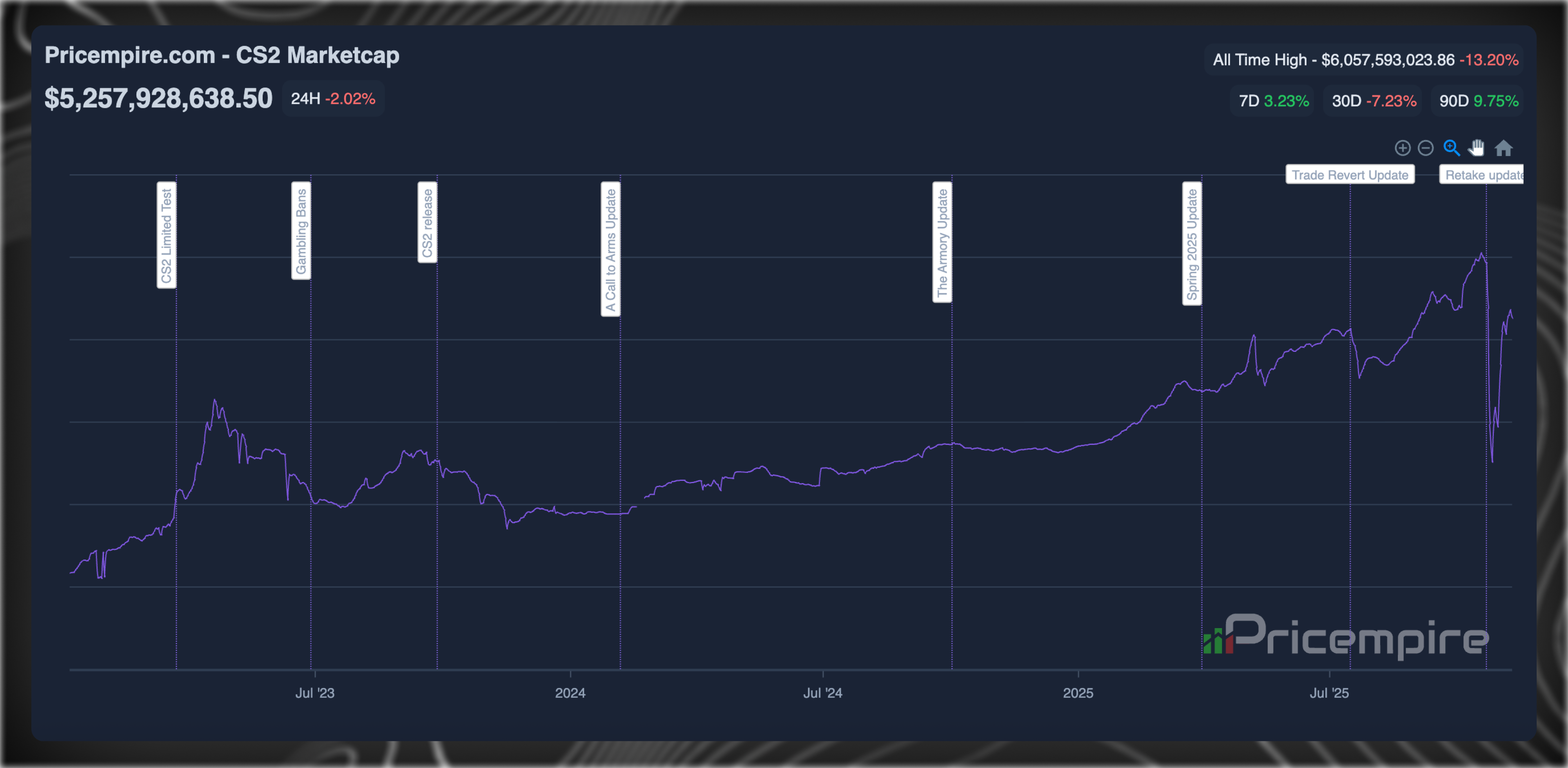
Counter-Strike 2 skin market capitalization peaked at $6 billion in 2025
Market has a problem
Most people trading skins are speculating—they buy low and sell high. Speed matters. They want to execute trades instantly. But that’s not how it works today. Trading speed is limited by Steam’s 7-day trade locks, peer-to-peer confirmation delays, and outdated infrastructure. Liquidity is spread thin across different platforms. Each platform has its own KYC requirements, limits, and restrictions. On top of that, traders are forced to keep their balances on third-party marketplace accounts. These funds aren’t really theirs—they can be frozen, lost, or stolen at any time.
https://x.com/pricempire/status/1987202906785771936
In short, the market faces a few core problems:- Liquidity fragmentation: Traders have to switch between platforms to arbitrage prices. They can’t instantly move funds between CSFloat, Buff, or Steam.
- Custodial risk: Traders can lose their funds at any moment—balances are stored on marketplace accounts controlled by the platforms.
- Slow execution: Steam’s trade locks and manual confirmations make instant arbitrage or quick exits impossible.
- High entry barrier: Many items cost thousands of dollars, which keeps smaller traders out of the market.
- Limited financial tools: There’s no leverage, hedging, or liquidity farming like in DeFi.
Inventory is the solution
Inventory solves these problems by bringing the market on-chain. If you’re not sure what that means yet—don’t worry, we’ll get to it on the next pages. In short, each item—like a Dragon Lore or a Karambit—becomes a liquid token that can be traded, pooled, or redeemed back for the real skin. This leads to:- Instant trading: No more waiting for trade locks or confirmations. Tokens move instantly.
- True ownership: Your balance lives in your Solana wallet, not on someone’s website.
- Unified liquidity: All items trade in one shared market, not across separate platforms.